
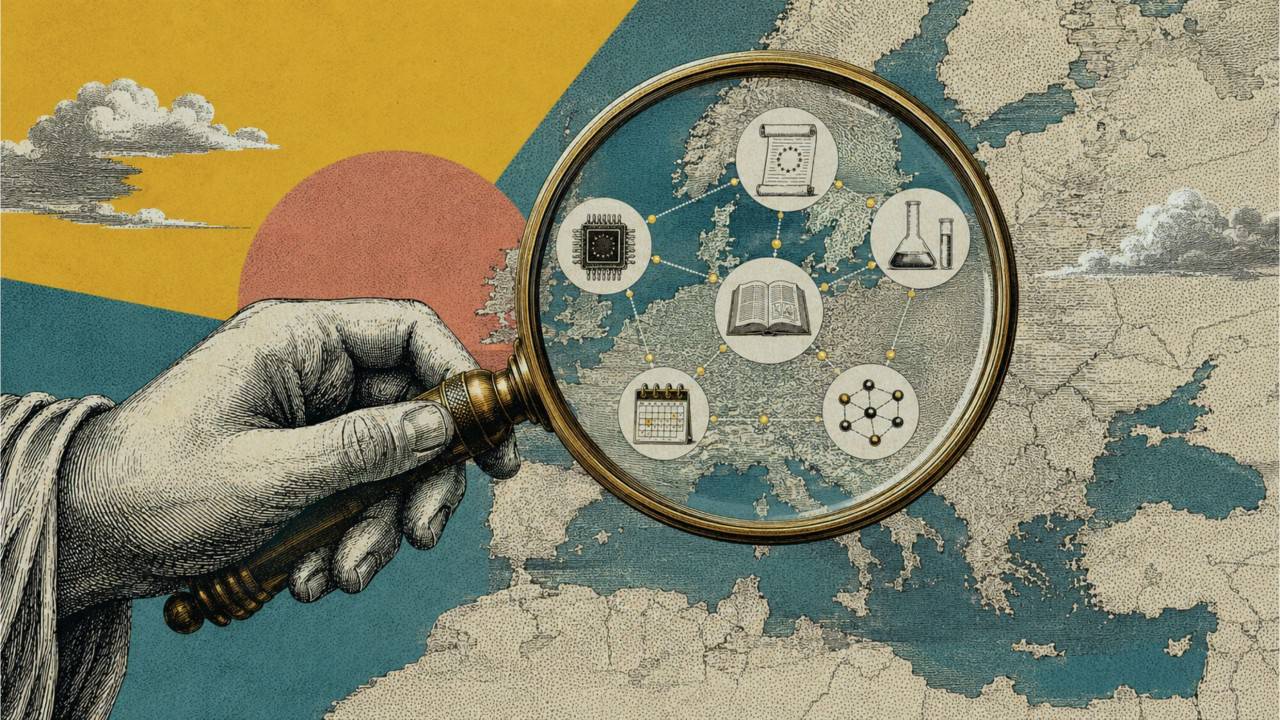
As with any relaunch, this first issue is very much a starting point rather than a finished product. Over the summer we will continue to fine-tune both the format and the content, with a second issue planned for mid-August before moving towards a more regular publication rhythm in the months ahead.
In this first edition, we begin with a look at some of the discussions already shaping the next Framework Programme and the European Competitiveness Fund, from the future of Joint Undertakings and FP10 to digital capacities and the role of the EU budget in supporting Europe’s long-term competitiveness.
Our News section brings together recent developments from across the INESC ecosystem and the wider European research and innovation community, including preparations for ADRF26 in Porto, reflections from our Summer Meeting on how Europe can better connect research excellence with industrial and societal capability, the launch of three new initiatives shaping the future of research infrastructures, developments in energy transition research, and an urgent appeal to support Ukraine’s Palladin Institute of Biochemistry following the recent missile strike that damaged its facilities.
Our new “Basics” section aims to unpack some of the concepts that frequently appear in European research and innovation discussions, beginning with a simple question: why does the EU invest in research and innovation, and what exactly is the European Research Area? Elsewhere, “Out of the Box” section explores emerging developments about sodium-ion batteries, while our selection of Open Calls highlights funding opportunities in energy, health, digital technologies and entrepreneurship.
As always, feedback, suggestions and ideas for future editions are more than welcome as we continue to shape the newsletter together with our community.
We hope you enjoy the read.
European Partnerships implemented as Joint Undertakings in the Next Horizon Europe 2028-2034 — The proposal suggests streamlining implementation modes and using a portfolio approach to identify a limited set of coherent partnerships, with objectives closely aligned with the European Competitiveness Fund. But how should Europe’s next generation Joint Undertakings be governed? INESC Brussels HUB has responded to the Commission’s Call for Evidence on the Single Basic Act, drawing on INESC’s direct experience within European Partnerships to argue for rules that keep research organisations at the heart of the model.
EARTO, together with 86 other associations representing key R&I stakeholders, published a joint declaration on FP10 in early July. The ask is simple: more budget, a strengthened Pillar II for collaborative research with industry, and coherence between FP10 and the ECF. It is rare to see research and industrial actors from so many sectors sign the same text, which says something about how much is at stake in the upcoming MFF talks.
EERA has published its position paper on FP10, “Secure Europe’s Innovation Continuity – From Science to Society”. The alliance calls for a budget of €200–220 billion instead of the proposed €175 billion, ring-fenced and additional to national investment, with collaborative research under Pillar II at no less than 60% of the programme. It also warns against a decline in clean energy research, proposes the SET Plan as the framework to align FP10 with the ECF, and asks for simpler grant processes, continued support for Widening, and safeguards for civilian research in the dual-use debate. The coordinator of INESC TEC’s Center of Power and Energy Systems, Ricardo Bessa, participated in the drafting of the position paper.
The European Commission has published a study on the EU’s critical digital capacities and their deployment beyond 2027, feeding directly into the preparation of the next funding period. The numbers speak for themselves: Europe counted over 20,000 advanced digital start-ups in 2025, yet only a small share managed to scale up, and investment gaps, skills shortages and market fragmentation continue to slow the deployment of AI, cloud and cybersecurity across the economy. The study also flags Europe’s continued dependence on non-EU providers for cloud, semiconductors and AI infrastructure. The final report of the study is complemented with 13 technology-specific annexes.
Annual EU Budget Conference 2026 — The Annual EU Budget Conference took place in Brussels on 2 July, with Commissioner Piotr Serafin for Budget, Anti-Fraud and Public Administration convening political leaders, MEPs and financial actors to discuss how the EU budget can better leverage private investment and deliver on strategic priorities. Competitiveness, long-term planning amid recurring crises, and the budget’s role in the Savings and Investments Union dominated the agenda; all themes that will shape the MFF talks in the months ahead.
Why does the EU invest in Research & Innovation?
Research and innovation are often associated with scientific discovery, but for the European Union they are also strategic tools. Investing in R&I strengthens economic competitiveness, helps address societal challenges such as climate change and public health, and reduces Europe’s dependence on critical technologies developed elsewhere. In an increasingly competitive global landscape, knowledge has become as valuable a resource as energy or raw materials.
This is why the EU invests billions of euros through programmes such as Horizon Europe: not simply to fund research, but to accelerate the journey from ideas to impact. Every project is expected to contribute, directly or indirectly, to Europe’s long-term priorities: a greener economy, a more digital society, resilient industries, and improved quality of life. In this context, research is not an end in itself, but a driver of Europe’s future prosperity and strategic autonomy.
What is the European Research Area (ERA)?
When people think of European research, they often think of Horizon Europe. Yet the framework programme is only one piece of a much broader ambition: the European Research Area (ERA). Launched in 2000, the ERA seeks to create a genuine single market for research and innovation, where knowledge, researchers, technologies and scientific infrastructures can circulate as freely as goods, services and capital do within the European Union.
In practice, this means reducing barriers to collaboration between countries, aligning national research policies, promoting open science, and ensuring researchers have access to world-class facilities and funding opportunities regardless of where they are based. More than a policy concept, the ERA is the foundation upon which initiatives such as Horizon Europe, European Research Infrastructures, and the mobility of researchers are built.
What if salt could help charge electric vehicles and power smarter grids?
Sodium-ion batteries are moving from lab tests to real products, offering a possible lower-cost alternative for selected electric vehicles and large-scale grid storage. Because sodium is widely available, this technology could help reduce pressure on critical raw material supply chains while supporting more affordable energy storage.
Energy storage is central to renewable integration, grid flexibility and energy security. Sodium-ion batteries may not replace lithium-ion everywhere, but they could become a strategic option where affordability, scale and resilience matter most.
Nothing linked yet.
Nothing linked yet.
Nothing linked yet.