The Insider Newsletter – 29 April
Europe has never lacked ambition. From the Green Deal to digital sovereignty, from health resilience to security innovation, the goals are clear enough. Declarations alone, however, do not deliver results. Progress depends on something far harder to define, and harder still to sustain: the institutions, relationships, and habits that turn strategic priorities into living ecosystems.
Across Europe, the organisations that drive research and innovation need to be seen by the non-R&I colleagues as much more than just fulfilling the traditional roles of knowledge production and some dissemination here and there. Oh.. the concept of dissemination… remember that one? Doesn’t really describe what we do, does it? Research Performing Organisations, or RPOs, are designing alliances, shaping agendas, building platforms. In short, they are becoming system builders. And whether we recognise it quickly enough will determine how well Europe meets the challenges it faces.
When I was finishing my degree in London, 25 years ago… isssh… I should not have said that, but writing without AI does have these particularities… the course director, the magnanimous Terry Sullivan, who was in the MI5 list for being a “political agitator”, told us: if you want to be famous with an academic article, use metaphors. For some reason, they tend to stick in people’s memory. Well… this newsletter is read by millions so the metaphor that follows will make me world famous.
I call it the “Fraunhofer Moment”. I could call it the TNO moment, the VTT moment, the JSI moment, the Lukasiewicz moment, the Tecnalia moment, the INESC moment… but Fraunhofer sticks better and there is available material to talk about it. All in all, it is a useful way of capturing the shift in mindset I am calling for. This is not about one institution or one strategy. It is about the growing understanding that research performing organisations, universities, RTOs, and hybrid actors like INESC TEC , have moved into the centre of Europe’s strategic capacity. Fraunhofer’s own transformation, through the High-Tech Strategy 2025 and its expansion in Heilbronn, is a strong signal, but not a solitary one.
From Trondheim and Aalborg to Warsaw, Leuven, Valencia, Coimbra, Porto, and Lisbon, a new type of leadership is emerging. Some institutions have cultivated this role for decades. Others are finding their place now. What matters is the common direction: stronger ecosystems, deeper alliances, and a sharper sense of purpose across the research and innovation landscape.
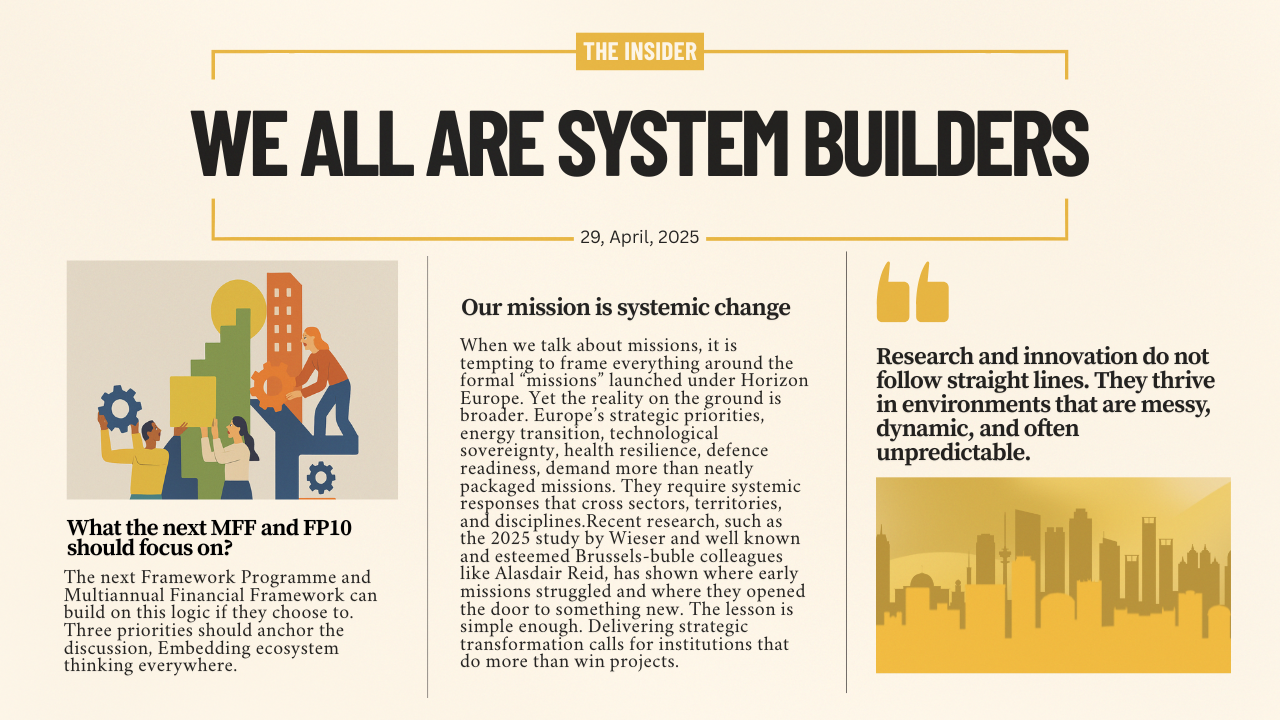
When we talk about missions, it is tempting to frame everything around the formal “missions” launched under Horizon Europe. Yet the reality on the ground is broader. Europe’s strategic priorities, energy transition, technological sovereignty, health resilience, defence readiness, demand more than neatly packaged missions. They require systemic responses that cross sectors, territories, and disciplines.
Recent research, such as the 2025 study by Wieser and well known and esteemed Brussels-buble colleagues like Alasdair Reid , has shown where early missions struggled and where they opened the door to something new. The lesson is simple enough. Delivering strategic transformation calls for institutions that do more than win projects. It calls for institutions that build connections, nurture flexibility, and sustain momentum across complex networks.
Research and innovation do not follow straight lines. They thrive in environments that are messy, dynamic, and often unpredictable. Success depends on more than the brilliance of individual projects. It depends on the quality of the frameworks that allow ideas, people, and investment to flow between sectors and stages.
Public policy needs to move from managing individual pipelines to cultivating environments where ecosystems can grow. This means supporting basic research without asking it to predict outcomes. It means enabling entrepreneurship without pretending that all good ideas start in a lab. It means treating infrastructures, education, finance, and regulation as parts of a living system, not isolated interventions. Well… it means thinking without prejudice. It means thinking clearly.
It also means changing the way public authorities see themselves or how they are managed, how their teams are built and organised. How many of us complain on a daily basis because funding agencies are organised like cash machines that could be replaced by not-so advanced algorithms? How many of us, who worked in those agencies, know how much more the excellent people working there could give to society, if trust and simplification were the rule? Policymakers have a critical role to play, in many fronts. To start, by not stopping at setting targets but actually working as partners to achieve them, by stitching together the conditions that allow ecosystems to adapt, align, and deliver at scale.
The next Framework Programme and Multiannual Financial Framework can build on this logic if they choose to.
Three priorities should anchor the discussion:
At INESC we have lived this evolution. We operate at the intersection of disciplines, sectors, and regions. We build alliances that last beyond projects. We connect research to industry, policy to application, ambition to outcome.
This way of working is not an accident. It is a deliberate choice, rooted in a belief that complex challenges can only be met by institutions that think systemically, act collaboratively, and lead with resilience.
As I mentioned before, Europe’s future will not be shaped by declarations alone, but I have to give credit to a person who was extremely inspiring as President of the National Innovation Agency in Portugal and is now my colleague at INESC TEC : José Carlos Caldeira . He said this the other day and it just stuck. Maybe we don’t need metaphors. Just to be bold and straightforward. I add: Europe is and will be shaped by those who build the systems that carry ambition forward. Research performing organisations have shown what is possible when they take that role seriously.
We are all system builders now. It is time to act like it.

The 2025 INESC Brussels HUB Summer Meeting, titled “Strategic Autonomy & Dual-Use R&I: Coherence, Capabilities & Europe’s Future,” will bring together research-performing organisations (RPOs), EU policymakers, national authorities, and industry representatives to examine how Europe can reinforce its strategic autonomy through research, innovation, and coordinated funding.
Russia’s war on Ukraine has shown how AI is reshaping modern conflict: autonomous systems, cyber operations, and intelligence gathering are moving at machine speed. Meanwhile, China and the US are locked in fierce competition, investing billions to dominate the next wave of military technology.
Europe is stepping up, though the challenges are clear:
According to a report by University World News , academics in the Netherlands are voicing serious concerns over a proposed screening law for incoming graduate students and researchers working in ‘sensitive’ fields.
Institutions such as University of the Netherlands ( Universiteiten van Nederland ) are pushing back, highlighting that the proposal could have unintended consequences:
As we prepare for the INESC Brussels HUB Summer Meeting 2025, focused on strategic autonomy and dual-use R&I, developments like this reinforce how deeply intertwined security, research, and talent mobility have become for Europe’s future competitiveness.
Two strategic options according to a recent Bruegel report:
Science used to sit comfortably above the partisan fray, but not anymore.
A recent analysis by M. Anthony Mills and Price St. Clair highlights how trust in science has become deeply polarised in the United States, driven increasingly by political identity rather than evidence.
As Mills and St. Clair argue, rebuilding trust requires more than mere information dissemination. It demands humility, demographic and ideological diversity within expert institutions, and meaningful public engagement in policy decision-making.
The path forward won’t be easy, but it’s essential:
science can only serve society effectively when it is trusted by society.
The European Commission has updated the European Research Area Forum’s “Living Guidelines on the Responsible Use of Generative AI in Research” document.
The guidelines highlight critical practices:
According to João Claro , Chairman of INESC TEC , Europe’s challenges are clear: restricted access to financing, regulatory burdens, limited talent attraction, and insufficient infrastructure for validating deep-tech solutions. To effectively tackle these barriers, INESC TEC recommends:
In a world where technological leadership increasingly defines economic strength, Europe’s future hinges on its ability to translate scientific excellence into industrial success. A new Joint Research Centre (JRC) report highlights how Research and Technology Organisations (RTOs) are playing a pivotal role in this transformation.
The report analyses how deep tech spin-offs, ventures built around cutting-edge scientific discoveries are driving regional reindustrialisation, creating new supply chains, and generating high-quality jobs.
The European Research Area (ERA) Scoreboard and Dashboard 2024 confirm substantial progress in advancing Europe’s research and innovation landscape from 2010 to 2022. Yet, they also underline that sustained investment and deeper structural reforms remain essential.
Key advancements were recorded in open science, gender equality, global engagement, and R&D spending.
However, the reports highlight persistent challenges:
Drawing on Mariana Mazzucato ‘s pioneering frameworks and refined through real-world EU mission experiences (climate-resilient cities, soil health, cancer prevention, and more), the study proposes a structured Theory of Action (ToA) for MOIPs.
Key pillars of the theory include:
The European Commission has officially launched the IPCEI Design Support Hub, a key step to streamline the development and approval of Important Projects of Common European Interest (IPCEIs). The Hub will work closely with Member States to help structure candidate projects significantly accelerating the process by enabling direct assignments in line with IPCEI rules.
The European Quantum Industry Consortium (QuIC) has released a new Position Paper outlining key recommendations to strengthen Europe’s leadership in quantum computing, communication, and sensing.
The paper identifies critical priorities:

On 6–7 May 2025, Warsaw will host the high-level conference “Technology Infrastructures: A Strategic Asset for European Competitiveness,” bringing together policymakers, industry leaders, and research organisations to advance Europe’s strategic agenda on Technology Infrastructures (TIs).
INESC Brussels HUB will play an active role in routing the debate, with Ricardo Migueis joining the panel for the strategic session “Towards a European Policy on Technology Infrastructures” alongside other members of the European Commission ’s Expert Group.
Main highlights include:
Date: 06 May 2025
Time: 15:45-17:00
Moderator: Dominik Sobczak , Deputy Head of Unit, European Commission
Presentation by Members of the Expert Group – Ricardo Migueis , Juliette Forneris , Andrea Fischer, Marie Suleau , Patrick Schelvis
At the VUB-ULB Usquare site in Brussels, UnILiON – Universities Informal Liaison Offices Network members convened for a full day of strategic discussions on the future of European research and innovation.
During the Open Talk session, Ricardo Migueis , Head of Office at INESC Brussels HUB , was invited to share insights on the systemic changes shaping Europe’s R&I landscape. His intervention focused on:
The exchange sparked a forward-looking debate with university representatives, reflecting growing awareness of the need for strategic adaptation in a shifting global context.
The day concluded with a guided visit to Usquare, a pioneering inter-university innovation hub showcasing collaborative research and education activities hosted by ULB and VUB.
Do you have any plans for your summer?
If you’re curious about research, and you are passionate about learning and creating, join us to go from theory into practice during INESC TEC ’s Summer Internships.
The INESC TEC International Visiting Researcher Programme (IIVRP) is now accepting applications for its 2025 edition, offering researchers from across the world the opportunity to collaborate closely with INESC TEC teams on topics of mutual interest.
Science shapes societies, influencing culture, driving technology, and underpinning progress.
At INESC TEC , we translate scientific knowledge into practical innovations that tackle today’s needs and anticipate tomorrow’s demands.
With a multidisciplinary approach spanning Artificial Intelligence, Energy Systems, Robotics, Health Technologies, and beyond, INESC TEC advances research and innovation at the intersection of science, technology, and industry.
See how we operate and where we are making a difference?
Key decisions:
The European Commission has released updates to the Horizon Europe Work Programmes for 2023 – 2025.
Frontiers , an initiative funded by the European Research Council, invites applications from science journalists worldwide for immersive residencies at European research institutions.
The latest thematic report under the Mutual Learning Exercise on Research Careers sheds light on how different national policy and legal frameworks can and must evolve to make research careers more attractive, stable, and sustainable.
Stay Connected with INESC Brussels HUB